Aging Is a Disease, not inevitable
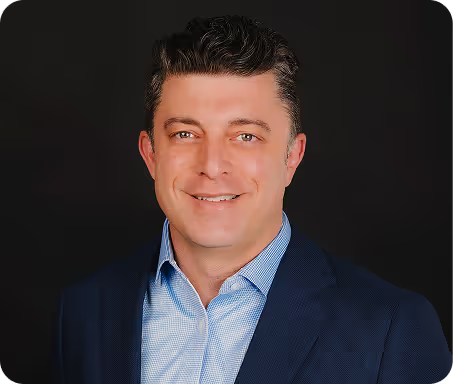
For most of medical history, aging has been treated as an inevitability, a background condition so universal it barely warranted a diagnosis. I’ve been a physician for over 20 years, and I recognize we built entire medical systems around managing its consequences: statins for the cardiovascular damage it causes, metformin for the insulin resistance it drives, antidepressants for the neurological toll it takes. What we never asked was whether aging itself could be the target. At Outlive Concierge Medicine, that question is the foundation of everything we do.
Science has caught up to intuition. Dr. David Sinclair's Information Theory of Aging proposes that aging is fundamentally a loss of epigenetic information, a progressive corruption of the molecular instructions that tell your cells what to be and how to behave. Your DNA, the hardware, doesn't change, but the epigenome, the software running on it, degrades. The Horvath Clock, DunedinPACE, and other epigenetic biomarkers now let us measure this degradation in real time, with a precision that would have been science fiction a decade ago. This isn't fringe biology. It's the emerging consensus of one of the most active fields in modern medicine.
The three main drivers of aging and why they matter clinically
Epigenetic decay doesn't happen in a vacuum. It's accelerated by three primary biological drivers that function both as downstream consequences of aging damage and as powerful feedback amplifiers that speed up the clock itself: chronic inflammation, insulin resistance and metabolic dysfunction, and mitochondrial decline. These aren't separate problems — they're a interconnected system. Chronic inflammation activates inflammatory signaling cascades that directly accelerate epigenetic aging. Insulin resistance drives mTOR overdrive, a molecular state that suppresses cellular repair and measurably speeds the Horvath Clock. Mitochondrial dysfunction depletes NAD+, the very molecule that sirtuins, the epigenetic guardians Sinclair's work centers on, require to function. Each driver feeds the others, and all three feed back into accelerated epigenetic decay.
"You're not just treating inflammation or metabolic syndrome in isolation. You're performing upstream epigenetic protection through metabolic medicine, slowing the master clock by addressing the mechanisms that drive it fastest."
Actionable today at every level
The most intellectually honest framework is what I think of as a multi-hit model. Epigenetic dysregulation is the master regulator — the upstream information architecture of aging. The three drivers above are its primary executors and its most powerful amplifiers. Intervening at any level has real value, but the deepest possible intervention is epigenetic reprogramming itself. The tools we have now to reprogram the epigenome are lifestyle (fasting protocols, resveratrol, quercetin), prescription medications (rapamycin, metformin), and more cutting edge peptides (epithalon, thymalin, GHK-Cu, vilon, vessugen, etc.). Dr Sinclair’s lab and other are working on gene therapy for the epigenome, but it is not yet available to the public, just in research trials.
Practically, the three drivers, systemic inflammation, insulin sensitivity, and mitochondrial dysfunction, are the most actionable targets available to us right now, because we have real, evidence-based tools for each of them.
Targeting inflammation - through omega-3 optimization, anti-inflammatory dietary strategy, and advanced lab monitoring - slows the senescence-associated secretory phenotype (SASP) that drives tissue aging and directly reduces the rate of epigenetic decay. Reversing insulin resistance - through fasting protocols, GLP-1 receptor agonists, and metabolic protocols - reduces mTOR overdrive and measurably slows biologic aging (Horvath Clock). Restoring mitochondrial function — through exercise protocols, NAD+ precursors, SQ NAD+ protocols, peptides such as SS-31 and MOTS-C, CoQ10, and methylene blue at hormetic doses — directly addresses the NAD+/sirtuin axis that sits at the center of Sinclair's entire theoretical framework.
This is what Medicine 3.0 looks like in clinical practice. Not treating the diseases of aging after they arrive, but intervening on the biological mechanisms that produce them — years or decades before a diagnosis is on the table. At Outlive Concierge Medicine, we don't wait for your body to break down to start paying attention. We measure, we optimize, and we treat aging as exactly what the science says it is: a modifiable, treatable disease process, and one that it's never too early to address.
Curious where your biological clock actually stands? Outlive Concierge Medicine offers comprehensive longevity panels and epigenetic age testing in Las Vegas. Book a free consultation to find out your real age — not the one on your passport.